Job Parameter
Job Parameter tables store parameter information for jobs.Examples of parameter information include pieces required, job, tool, required by, process limits, setup sheets, profile definitions, material components, and labor requirements.
There are several sets of tables that store job parameters.
Product Standard tables define product standards.
Work Order tables define unscheduled jobs.
Job Queue tables define scheduled jobs not currently running.
Current Job tables define parameters for currently running jobs.
History Tables contain both Job Parameter and Production information.
Job Totals contain job total information.
Shift Totals contain shift total information.
Materail Lot Totals contain material lot information.
Labor Totals contain employee production information.
Tote Totals contain tote production information.
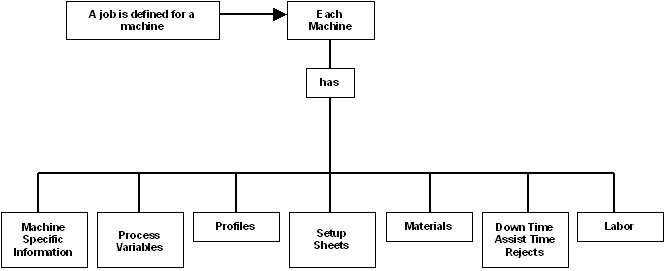
Most of the Job Parameter tables have a similar design. General job information -- such as job name, product and the tool used -- is stored in a "base" table. This table has records for each child in family jobs. Information relating to materials is stored in another table that has a direct link back to the "base" table. Information relating to specific machines, setup sheets, process variables, profiles, down time, assist time and reject count information is in a different table. Thus, information for a currently running job is stored across seven tables. Since setup sheets, process variables, profiles, and material information applies to the entire family of jobs (in other words to the machine), child-specific records do not exist in these tables. However, rejects are child-related for tables that store both Job Parameter and Production information (such as ss_hist_dar) and so the table containing down, assist, and reject information is child-specific. The following picture illustrates this database concept.