Major Table Relationships
Graphic relations have been provided for several related sets of tables listed here.Product Standard Parameters
Work Order Parameters
Queued Job Parameters
Current Job Parameters
Current Job Production Counts
Current Shift Production Counts
Historical Shift Production Counts (completed shifts or completed jobs on current shift)
Historical Job Production Counts
Historical Material Lot Counts
Shop Floor Definitions (partial diagram)
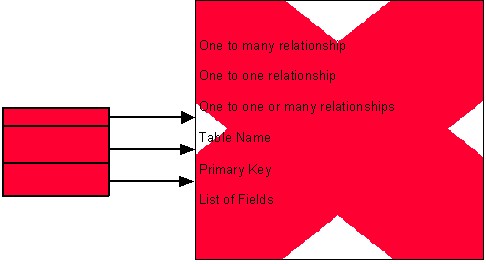
The diagrams use different symbols to illustrate tables, keys, and the relationship between tables. A table is depicted by a rectangle. It has a unique singular name that is listed at the top of the rectangle. Underneath the table name is the primary keys that identify a unique record within the table. Under the primary key(s) is a list of general fields that are stored within the table, in alphabetic order.
A line with arrowheads at either end depicts relationships between tables. The number of arrowheads represents the number of associated records between tables. For example, if two tables hold related information, a line will be drawn between them. If both ends of the line have a single arrowhead, the link between these tables is one to one, If the line has one arrowhead on table A and two arrowheads on table B, table A has a one to many relationship to table B and each record of table A can have multiple entries in table B. If both ends of the line have multiple arrows, table A has a many to many relationship to table B.